GATHER · TRADE · BUILD
The Settlers Table
A living island. Four ambitious settlers. One path to victory.
Play now3–4 players · Solo and online · Saved to your KIX account
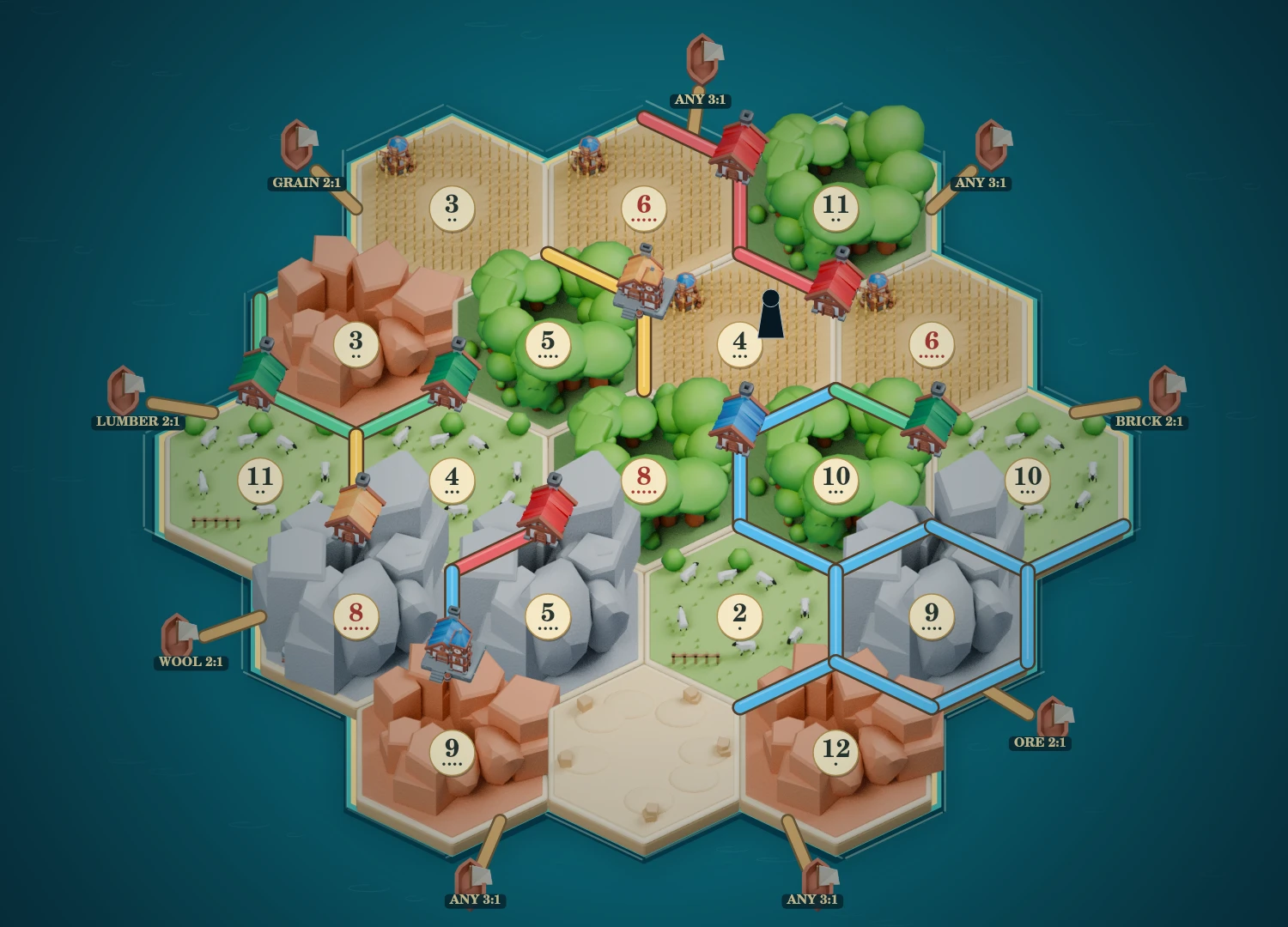
YOUR FIRST ISLAND
How to play The Settlers Table
Build a network of settlements, roads and cities. Collect resources, trade for what you need and be the first player with 10 victory points on your own turn.
Resources are your building materials. Lumber, brick, wool, grain and ore are game cards. They are separate from your KIX token wallet.
1. Open a table
Choose a color and a three- or four-player table. Solo fills the other seats with computers. For online play, host a public or invitation-only table, optionally add an access key, and share the invitation code. Guests press Ready; the host starts. Empty seats become computers.
2. Place your starting settlements
Choose one glowing intersection, where hex corners meet. Then place a road along an adjoining highlighted edge. Everyone places once in turn order, then again in reverse order. The last player therefore places their two settlement-and-road pairs consecutively.
A settlement cannot touch another settlement or city: leave at least one empty intersection between buildings, including your own. Starting settlements do not have to connect to each other. Your second settlement gives you one starting resource from each adjacent producing hex. The first settlement does not give starting cards.
3. Roll, collect, then make your moves
Roll two dice. Their total determines which numbered hexes produce. Every player with a settlement beside a matching hex receives one resource from that hex. A city receives two. You collect on other players’ rolls, too. The robber blocks its hex; the desert never produces.
The dots under a number show its frequency. A 6 or 8 is much more likely than a 2 or 12. Mix productive numbers with a useful variety of resources when choosing where to settle.
After rolling and resolving the robber if necessary, you may trade and build in any order, as often as your resources and available pieces allow. Press End turn when finished.
4. Build your network
| Build | Cost | Benefit |
|---|---|---|
| Road | 1 lumber + 1 brick | Extends your network; no points by itself. |
| Settlement | 1 lumber + 1 brick + 1 wool + 1 grain | 1 point; collects one resource per adjacent producing hex. |
| City | 3 ore + 2 grain | Replaces your settlement; worth 2 points total and collects twice as much. |
| Development card | 1 ore + 1 wool + 1 grain | A private action or victory point. |
Roads belong on edges and must connect to your road or building. An opponent’s building blocks a road connection through its intersection. After setup, new settlements must connect to your roads and obey the spacing rule. Cities upgrade your existing settlements.
Select a build button, choose a highlighted location, review the cost and confirm. You have at most 15 roads, 5 settlements and 4 cities in play. Upgrading a settlement returns that settlement piece to your supply.
5. Trade for what you need
Bank: trade four identical resources for one different resource. A settlement or city on a generic harbor improves this to 3:1. A resource harbor trades its matching resource at 2:1. The game applies your best rate automatically.
Players: on your action phase, send another player a specific offer. Choose what you give and what you want. They may accept or decline; you can cancel a pending offer. Computers evaluate offers using their own resources. They do not send repetitive unsolicited offers. All trades must involve the player taking the turn. You cannot trade development cards, buildings, or the same resource in both directions.
6. When a seven is rolled
A seven produces nothing. Each player holding more than seven resource cards must choose and discard half, rounded down. Eight or nine cards means discarding four. Development cards do not count. Once discards are complete, the active player moves the robber to a different hex.
If another player has a building beside the new hex and at least one resource, choose one such player and steal one random resource. You do not choose the stolen resource. The robber stays there and blocks that hex’s future production.
7. Development cards
The deck contains 25 cards: 14 Knights, 5 victory points and two each of the three progress cards. Your cards are private. You may buy several in a turn, but play only one action card per turn, and never the turn you bought it. You may play before rolling or after resolving the roll.
- Knight: move the robber and steal. A knight does not trigger discards. Played knights remain counted toward Largest Army.
- Road Building: place two legal roads for free, or fewer if your remaining pieces or legal locations limit you.
- Year of Plenty: take any two resource cards available in the bank.
- Monopoly: choose a resource and collect all cards of that type from the other players.
- Victory point: adds one hidden point. These cards count immediately toward winning on your turn, even when just purchased.
8. Bonus points and victory
Longest Road (+2 points): the first continuous route of at least five road segments earns the bonus. Branches are not added together; the game finds your longest connected trail without counting an edge twice. Opposing buildings can split it. A longer route takes the award; a tie keeps the existing holder if they still qualify. If the old holder no longer qualifies and multiple players tie for the lead, nobody holds it.
Largest Army (+2 points): the first player to play three knights earns the bonus. Another player must play more knights to take it.
Reach ten points on your own turn to win. Your display includes your hidden point cards; opponents see only your public points until the game ends. Merely possessing the most resources does not win.
Bank shortages, saves and reconnecting
There are 19 cards of each resource. If a production roll owes more of a resource than the bank holds, no player receives that resource. Exception: if only one player is owed it, that player receives the remaining cards. Other resource types still pay normally.
Confirmed moves save automatically. Close the page and return to resume. Solo play waits for you. At online tables, a computer can cover an inactive seat after three minutes; returning restores human control. Choosing Leave table gives up your seat permanently. Computers fill or cover seats without seeing opponents’ hidden hands or the development deck.
Eligible completed games use the existing KIX completion reward setting, normally 10 tokens. Leaving early or making fewer than five human actions does not qualify. Rewards and achievements are recorded once per game.
Reading the board
The latest action sits directly above the island. Your five resource cards are below it. Glowing intersections and edges indicate legal choices. Select any hex to inspect its production and neighboring buildings. Use Fit island to reset zoom; when zoomed in, drag to pan. Choose by location provides keyboard-accessible choices. Sound and motion effects can be switched off independently.